IAHS News
IAHS Academy 2027 Open Call for Topics
April 2026
The 2027 IAHS Academy, in Ningbo from 11 to 17 January 2027 and hosted by Eastern Institute of Technology, is jointly organised by the IAHS, UNESCO Intergovernmental Hydrological Programme (IHP), UNESCO World Water Assessment Programme (WWAP), World Meteorological Organization (WMO), the Eastern Institute of Technology, Ningbo (EIT) and Tsinghua University, Beijing.

Following the success of the first edition in Ningbo (January 2026), the IAHS Academy 2027 is expanding and launching an open international call to define up to five advanced short courses in hydrological sciences.
We invite leading scientists, lecturers and research teams worldwide, including those outside IAHS, to submit proposals for a week-long course combining:
- Advanced theoretical lectures
- Hands-on training (Python, R, MATLAB, etc.)
- Real-world case studies.
The IAHS Academy aims to:
- Strengthen global capacity in hydrology
- Support early-career scientists
- Promote open science and international collaboration
- Bridge research, data, and operational applications.
We encourage keynote lecturers from geomorphology, geology, environmental sciences, earth sciences, earth observation, artificial intelligence, statistics and any other discipline/topic addressing water challenges. The deadline for topic proposals in 8 May 2026. A template to submit your proposal to become a keynote lecturer is available here, or contact the IAHS Academy Chair by email ([email protected]). We are looking for topics such as:
- Strong scientific relevance
- Active international communities
- Available training material and tools
- Capacity to attract participants globally.
Lecturers will play a key role in shaping the next generation of hydrological scientists and contributing to a growing global network.
IAHS Academy Permanent Steering Committee:
Fernando Nardi (IAHS Academy Chair, University of Rome Tor Vergata, Italy)
Abou Amani (UNESCO IHP)
Antonio Annis (IAHS, University of Padua, Italy)
Dominique Bérod Berod (World Meteorological Organization)
Fabio Castelli (UNESCO Chair, University of Florence)
Christophe CUDENNEC (IAHS Vice-President)
Moctar DEMBELE (IAHS Early Career Scientists Committee Chair)
Maria C. Donoso (UNESCO Chair, Florida International University)
Miguel Doria (UNESCO WWAP)
Salvatore Grimaldi (IAHS President)
Fuqiang Tian (IAHS Vice-President)
Chunmiao Zheng (Eastern Institute of Technology, Ningbo, China)
Podcast Launch: History of Hydrology Interviews
April 2026
“The number one piece of advice I would give anybody is to pick a problem and go after that problem. Ideally, you should pick a problem that requires a lifetime to solve.” Prof. M. Sivapalan, episode 1.
“A lot of greybeards telling us what we should be doing is absolutely the wrong way to do science. Science is anarchic, it’s bottom-up.” Prof. Mike Kirkby, episode 2.
“I wrote to the journal editor asking what the record of rejected papers in a row was, because now that I had five in a row I really wanted to go for the record." Prof. Keith Beven, episode 3.
“Curiosity and fun are the main drivers of any scientific endeavor.” Prof. Georgia Destouni, episode 4.
These are some of the inspiring, insightful and often funny quotes that you can now hear in the newly-launched History of Hydrology Interviews podcast. In each of the 19 episodes, a member of the IAHS History of Hydrology Working Group interviews a senior hydrologist that has put their mark on the history of our field. Here is everything you need to know about this interview series, why there is now a podcast, and how you can contribute by recording an episode yourself!
What are the History of Hydrology Interviews?
Operating within the International Association of Hydrological Sciences (IAHS), the History of Hydrology Working Group is a global community effort to document the development of hydrology as a scientific field. As part of this initiative, members of the Working Group have conducted interviews with hydrologists who have written this exact history. They explain what drove them to become hydrologists in the first place, discuss the challenges and achievements of their careers and share advice for young hydrologists. Since the series’ launch in 2019, 19 interviews have been recorded and posted on the History of Hydrology YouTube channel. They are generally between 45 minutes and an hour long. As an example, here is the latest addition: Interview with Professor Petra Döll.
Why is there now a podcast?
The goal of the podcast release is to make these interviews easier for the global hydrology community to access. Videos are not the easiest format to fit into a busy schedule while a podcast is easy to listen to during a commute or on a walk. In addition, we have cleaned up the audio quality where possible to improve speech clarity and reduce background noise. The interviews are now available on Spotify, Apple Podcast, or “wherever you get your podcasts”.
Can I propose and conduct an interview myself?
Yes! Interviews are open to contributions from the community. The main requirements are that the interview be conducted in English and that the interviewee has been involved in hydrology over several decades. We particularly encourage interviews with female hydrologists, hydrologists from the Global South, and other hydrologists currently underrepresented in our interview series. For guidance on conducting an interview, feel free to contact the interview coordinator, Professor Okke Batelaan ([email protected]).
SYSTA Deadline is Approaching!
April 2026
SYSTA (Sivapalan Young Scientist Travel Award) funding is available for two exciting new events;
- The 10th International Symposium on Integrated Water Resources Management (IWRM) taking place from 9-13 September 2026 in Canberra, Australia
- The IAHS International Commission on Continental Erosion (ICCE) symposia taking place from 17-19 September 2026 in Como, Italy
SYSTA funding is available to eligible early career scientists who meet ALL of the SYSTA award criteria. Applicants should email the completed SYSTA application form and a copy of their published paper and conference abstract to IAHS Secretariat ([email protected]). Before submitting the application form, applicants should read the “Guidance on completing the SYSTA application form” document. Applications and published paper must be in English.
27th WaterNet/WARFSA/GWP-SA Call for abstracts
April 2026
IAHS is pleased to be a partner in the upcoming 27th WaterNet/WARFSA/GWP-SA Symposium on harnessing artificial intelligence and big data to enhance climate resilience in integrated water resources management in Eastern & Southern Africa.
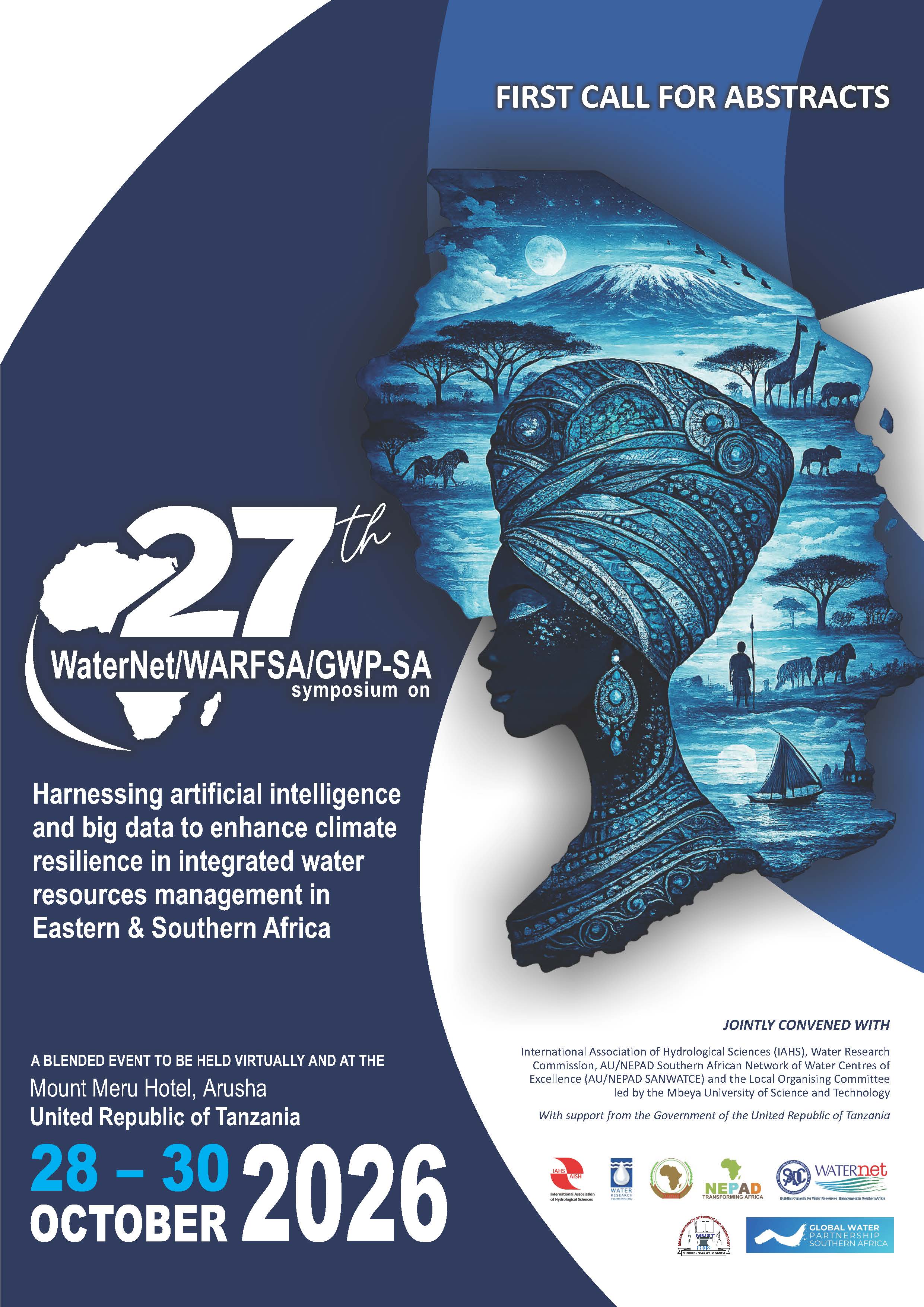
The symposium will be held in Arusha, United Republic of Tanzania, at Mount Meru Hotel, 28 – 30 October 2026. The symposium will be hosted by the Mbeya
University of Science and Technology in collaboration with other partners.
The Symposia have been held annually in the Eastern and Southern African regions for the past 26 years to promote interaction among policymakers, academics, practitioners from water and related sectors, and cooperating partners. Together, they identify regional issues, gaps and priorities that require further research and support. Great emphasis has been placed on integrating knowledge, particularly involving scholars from the natural and social sciences.
Deadline for submission of abstracts: 30 May 2026
Notification acceptance of abstracts: 30 June 2026
Deadline for early bird registration: 30 July 2026
This year's symposium sub-themes have been aligned to the SADC Water Research Agenda under the Regional Strategic Action Plan (RSAP) on Integrated Water Resources Development and Management Phase V, whose main objective is:
- Promoting evidence-based implementation of SADC water programmes and projects through multi- and inter-disciplinary research, and synthesis of existing and new information, which will lead to a realisation of SADC developmental goals.
Authors are invited to submit their abstracts for presentation at the symposium for oral, poster or special session presentations. More information is available here.
April Issue of the HSJ Digest
April 2026
In this second issue of 2026, we introduce a recently appointed sixth Co-editor, Pedro Chaffe, and are delighted to welcome him on board: read all about Pedro’s background in our regular ‘Meet the Editor’ slot. We offer synopses of multiple Open Access articles in this issue, together with featured articles and other ‘hot topics’, and we announce the winner of the 2025 Frances Watkins Memorial Award. Find out too about our new collection of papers curated by the MOXXI Working Group. Read it all here.

Introducing the IAHS Fellow Award
March 2026
The IAHS is pleased to announce the introduction of a new distinction: the IAHS Fellow Award. This prestigious recognition has been established to honour outstanding contributions to the hydrological sciences community and to celebrate excellence across the global IAHS network.
Award Overview
The IAHS Fellow Award will be presented every two years, recognising five distinguished scientists—one from each continent (North America, South America, Africa, Asia-Oceania, and Europe). This structure reflects IAHS’s commitment to global representation and inclusivity within the hydrological sciences.
Ceremony and Recognition
Awardees will be formally recognised during the IAHS Scientific Assembly and the IUGG General Assembly. Each Fellow will also be invited to deliver an oral contribution, either within a dedicated session or as part of the wider scientific programme.
Eligibility and Nominations
Candidates must be established scientists holding a permanent position, with a minimum of 10 years of research experience following the completion of their PhD. Nominees should also be current IAHS members. Nominations may be submitted by IAHS National Representatives, IAHS Officers, or IAHS members, ensuring a broad and inclusive nomination process. In addition, awardees are encouraged to contribute to the Hydrological Sciences Journal (HSJ). Ideally, recipients will have published at least one HSJ paper within the three years prior to the award and will be invited to submit a review or research paper highlighting their work within one year of the award ceremony.
Selection Process
Nominations should be received by the IAHS President and Secretary General (with a copy sent to [email protected]) no later than 31 December of the previous year. The selection will be carried out by a jury composed of the IAHS Management Team.
Commitment to Equity, Diversity and Inclusion (EDI)
IAHS is committed to achieving a balanced representation across gender and scientific disciplines in the selection of Fellows.
This new award represents an important step in recognising excellence and strengthening the global hydrological sciences community. Further details on the nomination process and timelines will be shared in due course.
The Digital Water Globe (DWG) is evolving!
March 2026
The IAHS DWG is entering an exciting new phase of development. Since its launch, the DWG has provided an innovative way to explore hydrological research across the world, helping to connect scientific knowledge and showcase the global reach of water science. As digital tools and scientific collaboration continue to evolve, IAHS is now taking the opportunity to redevelop the platform to better support the needs of the international hydrological community.
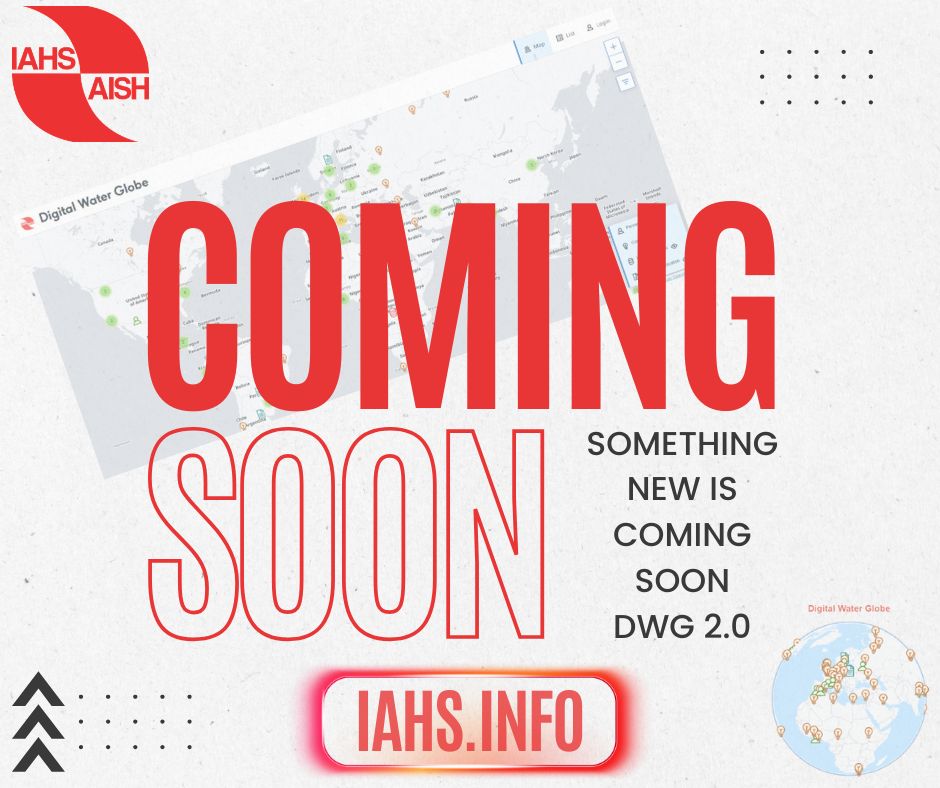
From the end of March, the current DWG will be temporarily unavailable while this redevelopment takes place. The next stage of development will introduce a new generation of the platform designed to enhance how hydrological research is visualised, shared, and explored globally. The aim is to create a more powerful and accessible tool that strengthens connections between researchers, disciplines, and regions. While work continues behind the scenes, IAHS will keep members informed as the project progresses and will share further updates in the coming months.
We look forward to welcoming the community back to a renewed and enhanced DWG very soon.
10th International Symposium on Integrated Water Resources Management (IWRM), 9-13 September 2026 in Canberra, Australia
March 2026
The 10th International Symposium on Water Resources Management (IWRM) will address the growing need for resilient and inclusive water resource management in the face of accelerating global change.
The 10th edition builds on the legacy of Integrated Water Resource Management (IWRM) symposia organized by ICWRS, particularly the 9th IWRM in Brazil (2024), while introducing a renewed focus on science-to-practice pathways. Hosting the event in Australia, a region confronting acute water security and climate resilience challenges, adds regional relevance and global significance.
Key topics include:
- Synergies between First Nations and technological knowledge and science
- Adaptive and resilient water systems design
- Decision support and co-design tools
- Local-global integration in water governance
- Trade-offs and synergies across societal, environmental, and economic domains.
The symposium will foster critical discussions and knowledge exchange among researchers, practitioners, and policy actors, with a strong commitment to involving early-career scientists and participants from underrepresented regions.
Invited Speakers:
- The Peter Loucks Lecture will be given by Holger Maier (Adelaide University)
- Prof. Junguo Liu (North China University of Water Resources and Electric Power)
- Prof. Troy Meston (Charles Sturt University, One Basin CRC)
- Prof. Bradley Moggridge (University of Technology Sydney)
- Assoc. Prof. Sally Thompson (University of Western Australia).
Presentation submission (Oral & Poster Abstracts):
- Please submit abstracts by 15 April 2026
- Authors will be notified of acceptance by 30 April 2026
- SYSTA application deadline 30 April 2026.
SYSTA (Sivapalan Young Scientist Travel Award) funding is available to eligible early career scientists who meet ALL of the SYSTA award criteria. Applicants should email the completed SYSTA application form and a copy of their published paper and conference abstract to IAHS Secretariat ([email protected]) before the deadline of 30 April 2026 at 09:00 GMT. Before submitting the application form, applicants should read the “Guidance on completing the SYSTA application form” document. Applications and published paper must be in English.
Field trips:
- Mulloon Institute 9 September 2026. Currently limited to 50 people
- Tidbinbilla Nature Reserve 13 September 2026. Includes a BBQ lunch and the nearby Deep Space Communication Complex visitor centre if there is interest and time. Please register your interest in joining these field trips on the registration page. Cost and details will be available later.
Organising Committee:
Barry Croke (Australian National University)
Pedro Luiz Borges Chaffe (Universidade Federal de Santa Catarina, Brazil)
Alberto Viglione (Politecnico di Torino, Italy)
Suxia Liu (Institute of Geographic Sciences and Natural Resources Research, Chinese Academy of Sciences, China)
Emmanouil Anagnostou (University of Connecticut, USA)
Gökçen Uysal (Eskisehir Technical University, Turkey)
Chris Leong (Research Institute for Humanity and Nature, Japan)
IAHS International Commission on Continental Erosion (ICCE) Meeting, 17-19 September 2026 in Como, Italy
March 2026
The IAHS International Commission on Continental Erosion (ICCE) symposia taking place from 17-19 September 2026 in Como, Italy. This marks the event's return to Italy after 20 years.
The symposia will bring together global hydrological experts to discuss cutting-edge research and solutions for the qualitative and quantitative assessment of soil erosion processes.
Important Dates:
- Abstract Submission Deadline 5 May 2026
- Early-Bird Registration 15 April 2026
- SYSTA Application Deadline 30 April 2026.
Scientific Topics:
- Erosion modelling and monitoring
- Sediment dynamics at catchment scale
- Wind erosion, tillage, alternative processes
- Prevention and soil conservation
- Mediterranean erosion perspectives
- Soil erosion and landscape evolution.
SYSTA (Sivapalan Young Scientist Travel Award) funding is available to eligible early career scientists who meet ALL of the SYSTA award criteria. Applicants should email the completed SYSTA application form and a copy of their published paper and conference abstract to IAHS Secretariat ([email protected]) before the deadline of 30 April 2026 at 09:00 GMT. Before submitting the application form, applicants should read the “Guidance on completing the SYSTA application form” document. Applications and published paper must be in English.
This is a unique opportunity to showcase your research, network with global experts, and contribute to shaping the future of hydrological and geomorphological sciences. Learn more and submit your abstracts here.
The ICCE Como 2026 Organising Team is looking forward to welcoming you to Como, Italy!
5th International Conference on African Rivers in Rabat, Morocco
March 2026
There are only 3 weeks remaining until the abstract submission deadline of 30 March 2026 for the 5th International Conference on African Rivers in Rabat, Morocco, 6-11 July 2026.
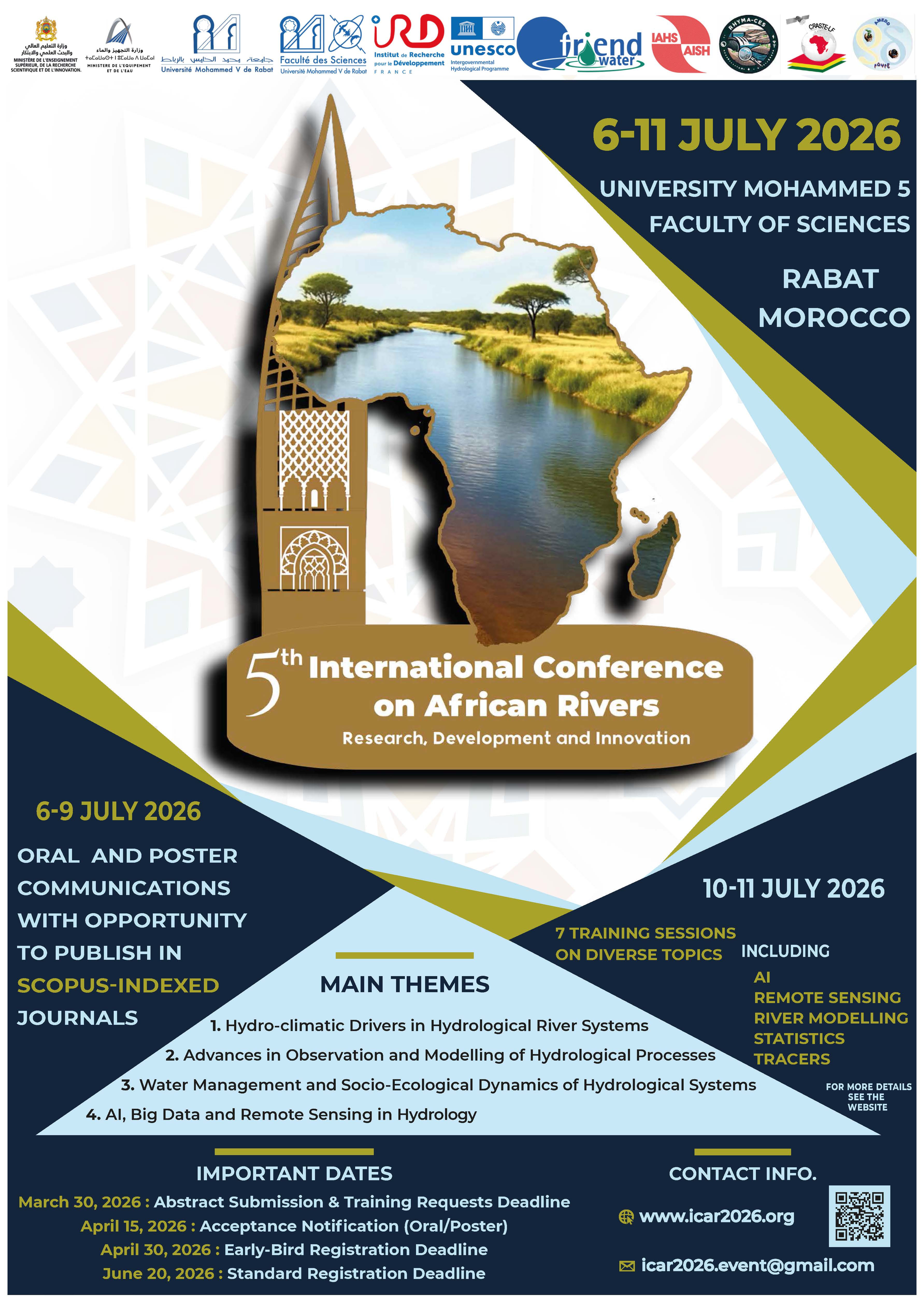
This event is sponsored by the IAHS, UNESCO IHP FRIEND-Water, WMO and IWMI, and co-organised by the University Mohammed V of Rabat, and IRD. The main themes include:
1. Hydro-climatic Drivers in Hydrological River Systems
2. Advances in Observation and Modelling of Hydrological Processes
3. Water Management and Socio-Ecological Dynamics of Hydrological Systems
4. AI, Big Data and Remote Sensing in Hydrology
The conference will be followed by 2 days with a choice of 8 training sessions, open exclusively to registered participants to the conference with official certificates of attendance. During the conference 6 discussion sessions will be dedicated to discussion workshops, on the Science/Society topics:
1. Co-creation of knowledge (with IAHS )
2. Transboundary water resources (with OIEAU)
3. Panafrican Youth and Blue Economy (with OPJEB)
4. Ancestral techniques of water use (with Moroccan experts)
5. Monitoring for risk reduction (with WMO)
6. From Satellites to Decisions: Strengthening Territorial Resilience Across Africa’s Large Watersheds (with IWMI).
After the conference 3 special issues in indexed journals are scheduled:
1. Hydrological Sciences Journal
2. International Journal of River Basin Management
3. Bulletin de l'Institut Scientifique.
SYSTA (Sivapalan Young Scientist Travel Award) funding is available to eligible early career scientists who meet ALL of the SYSTA award criteria. Applicants should email the completed SYSTA application form and a copy of their published paper and conference abstract to IAHS Secretariat ([email protected]) before the deadline of 30 March 2026 at 09:00 GMT. Before submitting the application form, applicants should read the “Guidance on completing the SYSTA application form” document. Applications and published paper must be in English.
Submission of abstracts and registration for training sessions are open until 30 March 2026. Do not miss this opportunity to meet continental and worldwide specialists of African rivers. Share and discuss your results and be part of the science/society discussions to build the "Rabat declaration" for the Future of African Rivers Resources.
We look forward to welcoming you in Rabat!