Dooge medal - For critical advancements to improve our understanding of climate warming as well as the cryosphere, hydrological processes, and hydrological predictions in cold regions and ungauged basins around the world - Prof. John Pomeroy, at the University of Saskatchewan, Department of Geography and Planning, in Canada.

The Dooge Medal was presented in October 2025 during IAHS2025 Scientific Assembly in Roorkee, India.
Citation for Prof. John Pomeroy by Prof. Salvatore Grimaldi
Professor John Pomeroy is the recipient of the 2025 Dooge Medal (International Hydrology Prize) of IAHS/UNESCO/WMO: For critical advancements to improve our understanding of climate warming as well as the cryosphere, hydrological processes, and hydrological predictions in cold regions and ungauged basins around the world.
Professor John Pomeroy studied at the University of Saskatchewan in Saskatoon, Canada, where he obtained a Bachelor’s degree in Physical Geography and, in 1988, a PhD in Agricultural Engineering. After posts as a Research Hydrologist in the USDA Forest Service, a NATO Science Fellow at the University of East Anglia, a Research Scientist at Environment Canada’s National Hydrology Research Institute, and a Professor (Personal Chair) at the University of Wales, Aberystwyth, Pomeroy returned to the University of Saskatchewan in 2003 as Professor and the Canada Research Chair in Water Resources and Climate Change, becoming Distinguished Professor in 2017.
He is internationally recognized as the world’s most cited snow hydrologist, whose groundbreaking research has transformed our understanding of hydrology in cold regions. His pioneering contributions to snow and ice hydrology, snow physics, glaciology, land surface processes, and hydrological prediction have fundamentally advanced both theory and practice. By developing comprehensive models of complex processes such as blowing snow transport, sublimation, infiltration into frozen soils, and energy balance snowmelt, he provided predictive tools now used worldwide, from small basins to continental river systems.
He helped to establish the discipline of snow ecology, revealing critical feedbacks such as glacier darkening by algae and early snowmelt impacts on wildfire risk. His leadership of coordinated networks and dozens of research basins has documented climate change impacts across Canada and globally, while his physically based models allow accurate hydrological prediction in ungauged basins.
As Director of Global Water Futures, the world’s largest university-led freshwater program, Pomeroy mobilized 23 universities, 200 academics, and over 2,000 trainees. His efforts led to new forecasting tools, Indigenous community partnerships, and the creation of the Canada Water Agency, Canada’s first national water management coordination agency. His outreach extends beyond science, from advising governments and the United Nations to public engagement through media, art-science collaborations, and UNESCO initiatives.
Professor Pomeroy’s exceptional mentorship, scientific innovation, and global leadership have set new standards in hydrology.
Therefore, it is my absolute pleasure and great privilege to award the 2025 Dooge medal to Professor John Pomeroy “for critical advancements to improve our understanding of climate warming as well as the cryosphere, hydrological processes, and hydrological predictions in cold regions and ungauged basins around the world.”
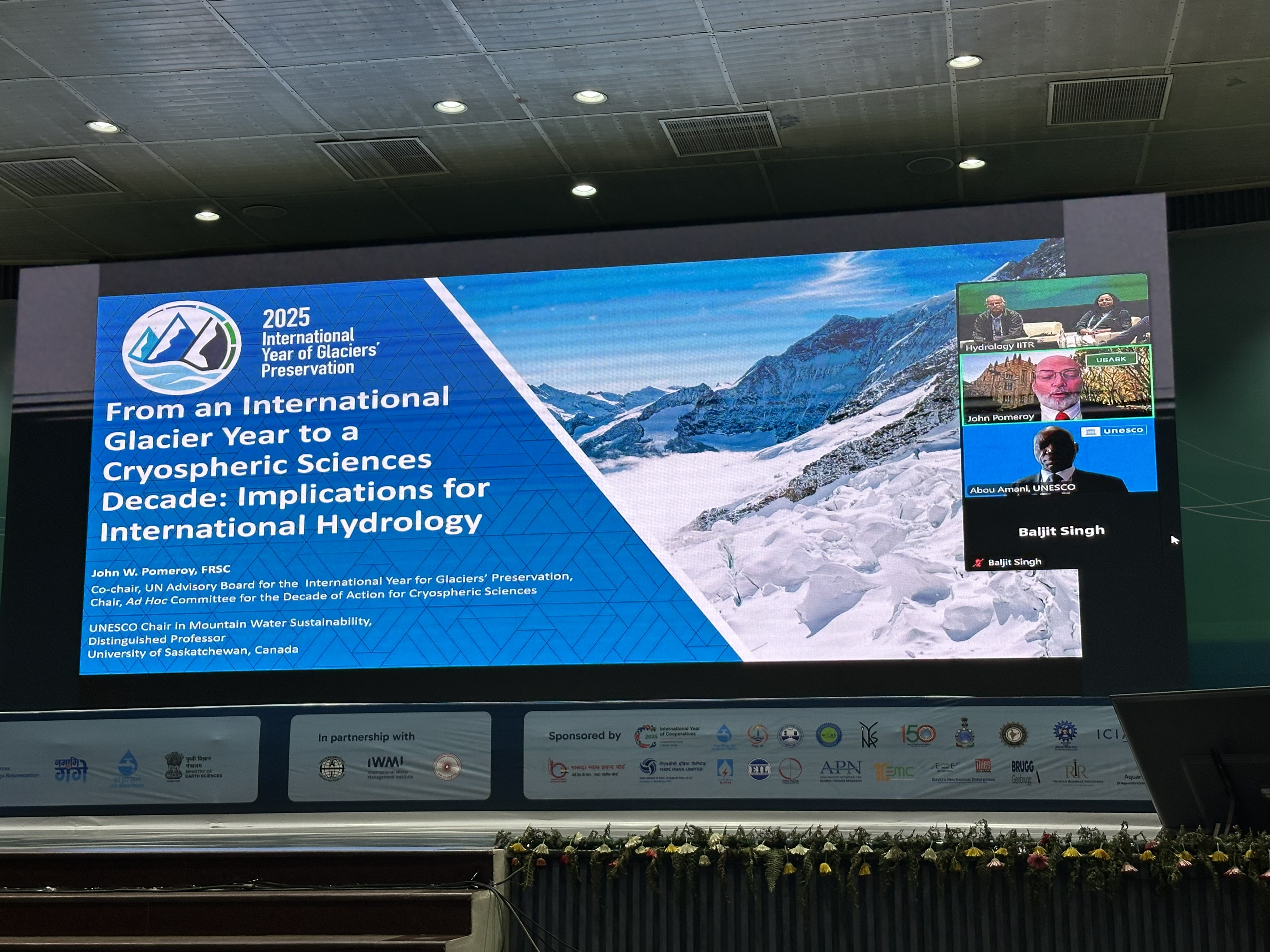
Response by Prof. John Pomeroy
Professor Grimaldi is very kind and generous in his citation which I greatly appreciate and am humbled by. It is particularly wonderful coming from the President of IAHS – the world’s essential scientific society for hydrology and one that I have enjoyed an association with since its spectacular conference as part of the IUGG in Vienna in 1991 – a vibrant meeting that I will long remember. After exposure to IAHS’s scientific culture as a young scientist, I became involved in several IAHS-ICSI working groups: snow chemistry, snow ecology and snow and climate. These produced seminal books edited by Trevor Davies, Martyn Tranter, Gerry Jones, Eric Brun and Richard Armstrong that are still referred to as classics. I was able to form a Snow-Vegetation Working Group that examined the role of snow and forests, grasslands, tundras and shrubs at a time when shrub expansion was becoming prevalent in the Arctic and forest disturbance was impacting water supplies in mountain headwaters around the world. When the International Commission for Snow and Ice decided to become the International Association for Cryospheric Sciences within IUGG, I felt that the topic of “snow and ice hydrology” might be lost in the gap between the new IACS and IAHS and so helped to form the International Association for Snow and Ice Hydrology (ICSIH) within IAHS, keeping this academic lineage as a fundamental part of international hydrology. Around the turn of the century, I entered into a novel online discussion, facilitated by IAHS, on the major problems in hydrology, one being that of prediction in ungauged basins. This led to a great interest in PUB, and working with hydrological giants such as Siva Sivapalan, Jeff McDonnell, Gunther Bloeschl and others to form the PUB Decade and later leading it for a two year period was not only great fun, but a fundamental advance in our science and its applicability to global problems. So IAHS has been a major part of my science DNA for a long time. At the University of Saskatchewan we have been fortunate to lead the Global Water Futures programme and have both a Global Institute for Water Security and a Centre for Hydrology – this makes it a truly great university at which to be a hydrologist, with strong roots going back to before the International Hydrological Decade, early leadership from Don Gray in the 1960s and many others, such as Howard Wheater, following that. I have always found science to be tremendous fun and wanted to be a scientific explorer since I was a youth. The greatest delight in science, besides working with brilliant students and colleagues, is the moment of discovery of a new principle, idea or finding. They glow very brightly at that moment. I hope that other scientists can find these delights working with the stellar colleagues and promising students that IAHS brings to collaborations. IAHS is truly the world’s essential scientific society, and with UNESCO and WMO, is leading the world through the polycrises of unsustainable water resource management and rapid climate change. No where is this polycrisis more evident than in snow and ice hydrology and the downstream impacts. I hope others will join to solve these urgent and existential problems for humanity.