Details of the Working Group
Resilient Water Futures - Methods, Tools, and Practices for Climate Adaptation: Lead by Aristeidis Koutroulis & Elisa Saveli
The Working Group will develop resources and frameworks to enable stakeholders to make informed decisions and build a more climate resilient and equitable water future. Activities will focus on creating interdisciplinary spaces, frameworks, tools, and research products that support climate adaptation to water-related risks and extremes. Specifically, group members will identify, categorize, and critically examine existing climate adaptation methods, tools and practices. Additionally, the working group will use relevant case studies from both the Mediterranean and other areas to identify lesson learned and effective adaptation and maladaptation practices. Lastly, the group will foster knowledge exchange among practitioners, researchers, and policymakers across the world. Our contributions will include:
- Mapping the landscape of climate adaptation methods, tools, and practices, critically assessing their access, effectiveness, usability, and adaptability across different users, regions and climates.
- Synthesizing insights from case studies to build a repository of best practices and lessons learned that enhance local resilience.
- Providing stakeholders with information on available resources for climate adaptation.
- Building a collaborative network that connects diverse stakeholders, enabling the continuous co-creation of climate adaptation and water resilience resources.
- Facilitating interdisciplinary knowledge exchange to support practitioners, policymakers, and researchers in implementing sustainable and equitable water resilience strategies.
View the proposal and sign up here and the Presentation will follow shortly.
Update: FutureMed COST Action – Advancing Climate Adaptation in the Mediterranean
As part of our ongoing work under the IAHS Working Group “Resilient Water Futures: Methods, Tools, and Practices for Climate Adaptation”, we are excited to share a major initiative, the 1st General Assembly and Training School of the FutureMed COST Action, to be held 29 September – 3 October 2025 in Chania, Crete.
This transdisciplinary event brings together climate scientists, policy practitioners, and regional stakeholders to explore climate extremes, impacts, and adaptation in the Mediterranean. The Assembly will feature thematic sessions on risk, justice, governance, and climate communication, with the Working Group 2 (WG2) of FutureMed at its core.
WG2 focuses on evaluating, classifying, and improving adaptation methods and decision-support tools. Activities include:
- Mapping of tools and practices for climate adaptation.
- Case study synthesis from across the Mediterranean and beyond.
- Knowledge exchange between scientists, decision-makers, and practitioners.
- Stakeholder-informed frameworks to support real-world application of water resilience strategies.
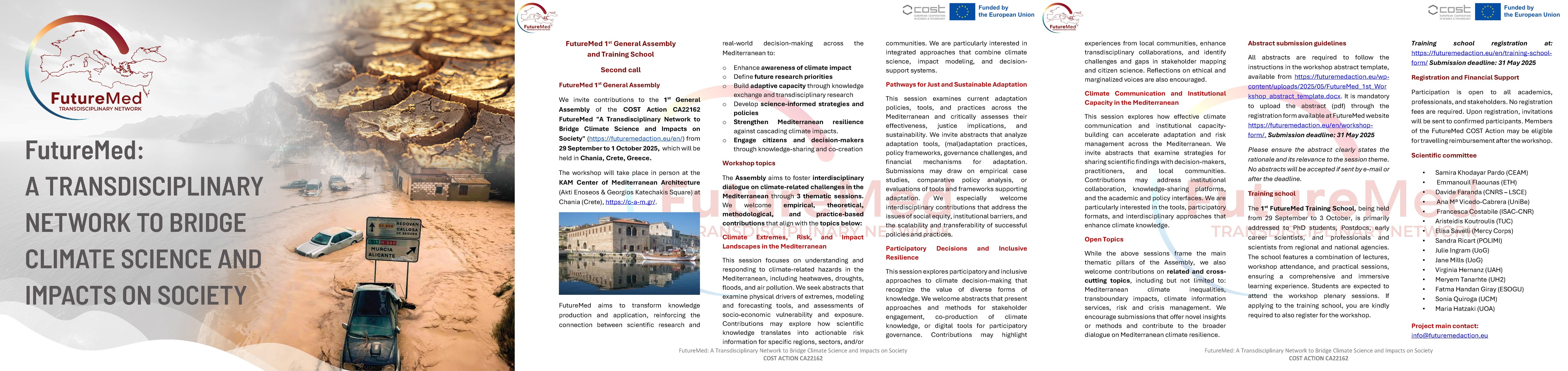
Call for Contributions: Abstract submission and Training School application are now open until 31 May 2025.
Visit the FutureMed website for full details.
This collaboration between IAHS Resilient Water Futures and FutureMed COST Action aims to co-create a just, informed, and climate-resilient Mediterranean future.
Update: FutureMed General Assembly & Workshop – Chania, Greece (29 September – 3 October 2025)
The Resilient Water Futures working group (HELPING WG 2.10) is closely linked to COST Action CA22162 “FutureMed – A Transdisciplinary Network to Bridge Climate Science and Impacts on Society”. FutureMed brings together more than 500 members from 42 countries to strengthen climate resilience across the Mediterranean region.
In September–October 2025, FutureMed held its 1st General Assembly, Workshop and Training School in Chania, Greece (29 September – 3 October 2025). The event focused on how to bridge climate science with impacts on society.
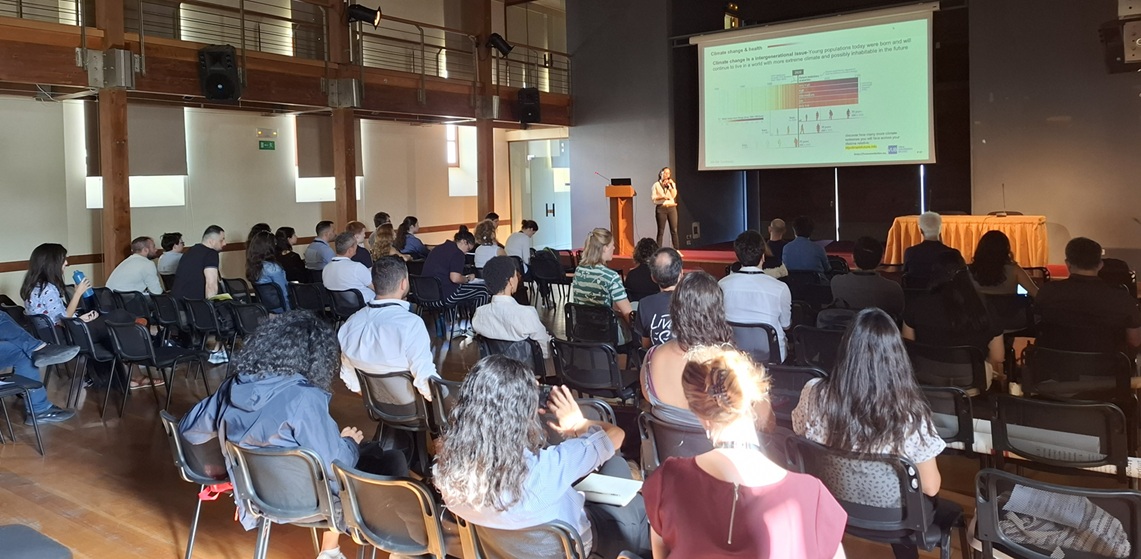
During the Chania General Assembly and workshop, WG 2.10 – Resilient Water Futures: Methods, Tools, and Practices for Climate Adaptation – connected its work with ongoing FutureMed activities. In particular, the WG contributed to the WG2 roundtable on “Pathways for Just and Sustainable Adaptation: Tools, Policies, and Practices for Resilient Mediterranean Futures”, where we discussed:
- how to document and compare climate adaptation practices in water-related sectors, and to critically examine whether tools are usable, co-designed and locally grounded, rather than mainly serving donor or project visibility needs;
- how to link hydrological information with stakeholder needs and measure “effective adaptation” in practice, including the role of common versus context-specific indicators across the Mediterranean;
- how to co-develop decision-support resources that are usable by practitioners and policymakers, while addressing questions of equity and justice (who adapts, who bears the burden) and the need for institutional arrangements, potentially including a Mediterranean-wide adaptation platform, that can support more ambitious, transformative climate adaptation.
Update: ADAPT Tools – Climate Adaptation Decision-Support in Practice
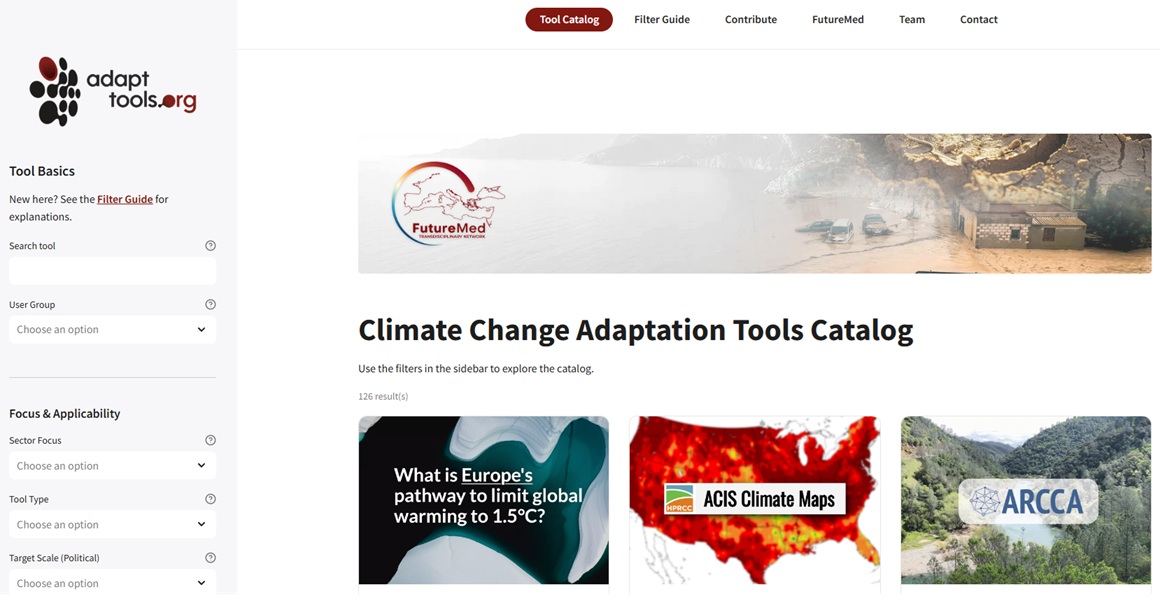
Through its collaboration with COST Action CA22162 FutureMed, WG 2.10 contributes to the development and use of ADAPT Tools, a collection of climate adaptation decision-support tools curated within FutureMed WG2 (Climate Adaptation Decision & Support Tools), see: https://adapt-tools.org/
The ADAPT Tools collection aims to:
- · map and describe methods, models and tools that support climate adaptation planning for water-related risks and extremes in the Mediterranean and similar regions,
- · provide practical information on each tool (intended users, spatial and temporal scale, required data, sectors addressed, level of expertise, and accessibility),
- · highlight open and freely available tools where possible, and
- · document examples of application and lessons learned, including challenges and limitations.
For WG 2.10, ADAPT Tools provide a concrete basis for:
- · building a typology of climate adaptation methods, tools and practices that can be compared across countries and contexts,
- · analysing which tools are being used (or under-used) in different water-related sectors,
- · identifying gaps, overlaps and potential risks of maladaptation,.
Call for contributions:
If you are using or developing a climate adaptation tool relevant to water resilience (e.g. decision-support systems, planning frameworks, scenario tools, risk assessment models), and would like it to be considered for inclusion in adapt-tools.org and discussed within WG 2.10, please contact us or use this link .